
AI is becoming a part of our lives. In today’s digital world, AI is being utilized by millions of people daily in a wide range of ways, from searching for a recipe to sending an email to answering a question in seconds.
AI is not a stand-alone entity. A large network of computers processes and generates the information and answers that a chatbot provides, and they work around the clock. There is a question everyone is asking: Does AI increase productivity, innovation, or convenience? As more researchers look into the question, it is getting a new focus: How does each prompt affect the environment?
The Energy Behind Each Prompt
While AI might appear to be a virtual technology, it is very real and tangible. There are several servers, processors, and power plants behind each sentence produced, which all come together to create an answer. Unlike traditional search engines, generative AI can analyze the web and present content that is relevant to a query. Large language models (LLMs) are machine-learning algorithms that are designed to generate a response using a large amount of data, which is processed in real time. This involves much greater computing power than normal online activities.
Scientists have started to estimate the carbon footprint of each and every AI request—and it is not pretty. German researchers assessed fourteen LLMs with simple multiple-choice questions and more complex open-ended questions. The higher complexity level led up to six times the emissions of CO₂ compared with the simpler questions requiring short answers. In addition, this study found that larger AI systems have much greater emissions than smaller systems.
The Rising Demand for Electricity
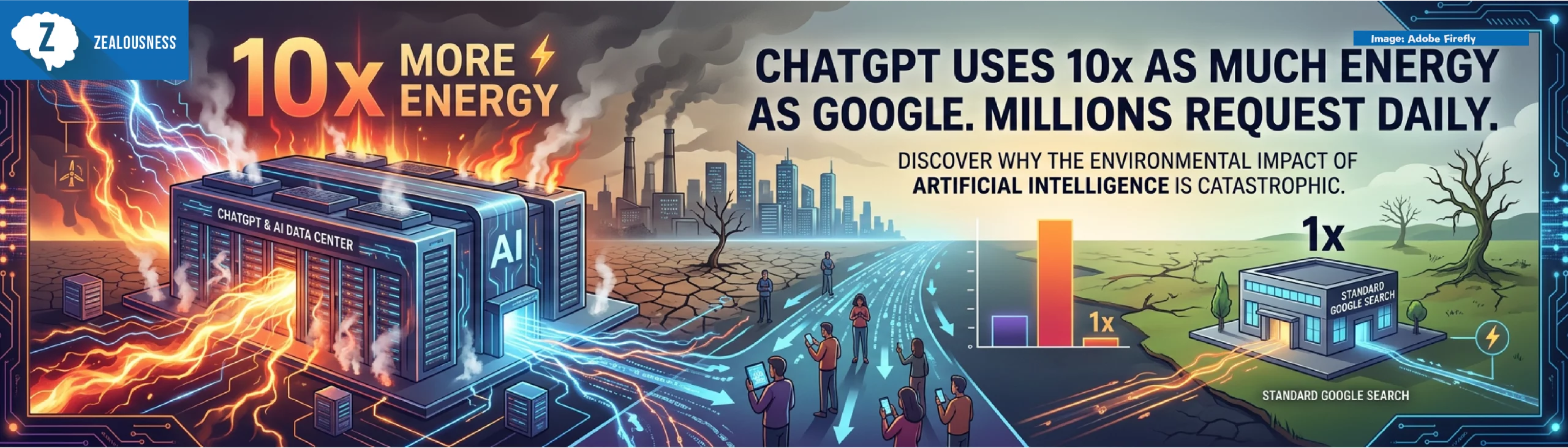
With the advancement of AI technology, electricity consumption is rapidly rising. Consider the long list of potential impacts of AI on the environment, and it is easy to see just how big the difference is in that context. While it might be just an application of electric power to a small number of requests, AI systems can handle millions of requests per day. The International Energy Agency (IEA) estimates that every request to ChatGPT emits ten times as much electricity as an average Google search. Now, millions of prompts are being produced every day by chatbots, AI image generators, and automated assistants. This has resulted in an increased energy demand throughout the world.
Much of this increase in electricity consumption has been blamed on data centers—huge buildings designed to store and process digital information. These facilities are packed with servers operating day in and day out. The servers then perform billions of calculations for each essay, image, summary, or conversation that AI generates in a single second. As the size and complexity of AI models increase, so does their energy consumption.
The Carbon Cost of AI
All AI answers have to be powered by electricity. While individual requests do not consume much, AI systems process millions of requests per day, and all of these requests require computing power. Electricity generation is still based on fossil fuels like coal, oil, and natural gas in many parts of the world. With the increased energy consumption of AI systems, a power plant has to produce more electricity, which raises carbon dioxide (CO₂) emissions.
CO₂ is one of the chief greenhouse gases that traps heat in the atmosphere. The more it accumulates, the warmer the temperatures get, and thus, climate changes around the globe. This is the relationship between a basic conversation with a chatbot and the overall impact it has. When combined with millions of users and billions of requests, the impact on carbon emissions becomes far more noticeable. Although the emissions generated by a single AI response might be small, the total emissions from the energy demands of AI are becoming a significant environmental issue.
The Impacts of Increasing CO₂ Emissions on Everyday Life
A rise in the amount of carbon in the atmosphere is associated with the following impacts:
- More frequent and severe heat waves
- More intense storms and flooded conditions
- Longer droughts
- Higher food prices due to damaged crops
- Increased wildfires
- Poorer air quality
- Greater stress on the power grid
The effects of these impacts can sometimes be “cascading.” This hunger for additional electricity will be greater in the winter months, when more heat is required, and greater in the summer months, when more air conditioning is needed. If the electricity is provided by fossil fuels, even more carbon dioxide is emitted into the air. There is also an increase in risks to the agricultural sector. Weather patterns that vary from droughts to flooding can decrease the production of crops, thus increasing the cost and reducing the availability of food for many communities. But if emissions of these gases increase over the coming decades, the disruption of our daily lives could become more frequent, more severe, and much costlier.
Final Thought
It is easy to ask a question to a chatbot. You type a sentence, wait for a few seconds, and an answer is given. The technology is very convenient, and it is easy to forget that there is so much infrastructure behind the screen. As AI becomes a part of everyday life, its impact on the environment can no longer be ignored.
Read more articles related to climate change on our Zealousness blog.
Reference
- Schwarz, Joachim, Wilhelm, Florian, and Henkel, Anna. “Carbon Emissions from Large Language Models: A Study of Computational Complexity and Environmental Impact.” Journal of Sustainable Computing, vol. 14, no. 3, 2023, pp. 245–258.
- International Energy Agency (IEA). “Electricity Demands of Artificial Intelligence and Data Processing.” IEA Technology Collaboration Programme, 2024, www.iea.org/reports/ai-electricity-impact.
- United Nations Environmental Programme (UNEP). “Climate Change 2024: The Physical Science Basis.” Intergovernmental Panel on Climate Change (IPCC), 2024.











Comments are closed.