

Fast Facts: What You Need to Know Before You Continue Reading
• Laser defense systems use focused beams of energy traveling at the speed of light to disable threats like drones and missiles
• Each laser shot costs only a few dollars in electricity, compared to millions for traditional missiles
• The U.S. Army and Navy are already deploying these systems in real-world operations
• Current challenges include power requirements, weather interference, and heat management
• This technology connects to STEM fields, including physics (optics and energy), engineering (cooling systems), and computer science (targeting algorithms)
Quick Takeaway for Younger Readers:
Laser weapons are powerful beams of energy used to stop drones and missiles. They’re fast, accurate, and much cheaper than firing missiles, but they still face challenges like bad weather and high power needs.
Not that long ago, most people thought of directed-energy weapons as something out of a sci-fi movie, not real military hardware. That’s changing quickly. The U.S. military is not just talking about lasers; they’re actually rolling them out and putting them to the test. These laser-based systems can blast drones, missiles, and other flying threats in real time, at the speed of light. What used to be a wild experiment is now a real player in defense strategy.
The challenge is that threats continue to evolve—they’re getting faster, cheaper, and more sophisticated.
Traditional missile defenses can’t always keep pace. Lasers change the game through precision, speed, and cost-effectiveness with no expensive ammunition, just energy.
This shift is prompting the military to rethink how they protect personnel, vessels, and critical assets. The future of defense is looking a lot like those sci-fi stories, only real.
What Does “Directed-Energy” Mean?
Directed-energy weapons use concentrated energy, such as lasers or microwaves, instead of physical ammunition. Rather than firing a projectile, these systems deliver intensely focused beams of light directly to a target to damage or disable it.
Key Concept: What Makes a Laser Special?
Unlike regular light (like from a flashlight), laser light is “coherent”—all the light waves travel in the same direction and are perfectly aligned. This allows the energy to be focused into an incredibly tight beam that can travel long distances without spreading out. When all that concentrated energy hits a target, it generates intense heat in one small spot.
How Laser Defense Systems Work (Simple Breakdown)
- Detection: Radar and sensors spot an incoming threat, such as a drone
- Tracking: Computer systems lock onto the target and predict its movement
- Firing: A high-energy laser is aimed at a precise point on the target
- Damage: Heat builds rapidly, causing the target to malfunction or fail
Laser defense technology isn’t science fiction anymore—it’s real, and it’s changing how we think about protecting against threats. Instead of firing bullets or launching missiles, these systems use focused beams of energy, directing high-powered lasers at targets until they overheat, short out, or just fall apart. Unlike traditional weapons, some military lasers like the PHASR rifle do not rely on explosions or shrapnel but instead use concentrated energy focused on a single spot. According to Wikipedia, the PHASR rifle is designed as a low-intensity laser that produces a temporary blinding effect rather than permanently neutralizing a target. Operators can disable drones, missiles, or even enemy sensors with pinpoint precision. And since a laser beam moves at the speed of light (186,000 miles per second), there’s virtually no delay between aiming and impact.
What you aim at gets hit, instantly. That’s crucialwhen you’re trying to stop something flying right at you.
Right now, most U.S. laser defense systems cover short to mid-range threats. Think drones, incoming rockets, artillery shells, and cruise missiles. They’re not sci-fi ray guns, but they’re getting pretty close.
Why the Military Is Turning to Lasers Now
Diagram Suggestion for Educators: A comparison chart showing cost per shot—traditional missile interceptor ($1-3 million) vs. laser shot ($1-10 in electricity)—helps students visualize the economic advantage.
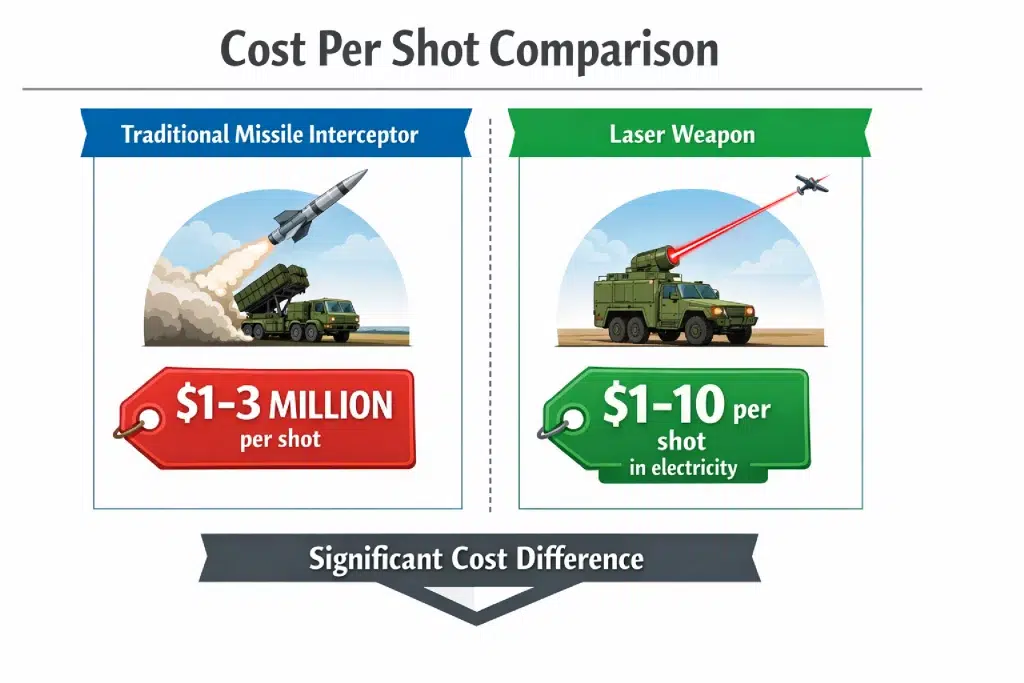
A few big reasons are pushing laser defense tech into the spotlight:
For starters, the types of threats out there have changed. Enemies now use cheap drones and swarm attacks, and old-school missile systems just can’t keep up. Firing expensive interceptors at low-cost drones creates an unsustainable cost imbalance.
Then there’s the cost. Once you’ve got a laser system up and running, each shot is basically just the price of a little electricity. No need to worry about stocking up on ammo. According to Time, as long as the system receives continuous power, it can remain operational, and its effectiveness relies heavily on its precise targeting capability. Operators can dial up the beam however they need. Maybe just to blind a sensor, maybe to punch a hole right through a target. Either way, you get control, accuracy, and way less risk of hitting something you shouldn’t.
Current U.S. Military Laser Defense Systems
Right now, the U.S. military is rolling out laser defense systems worldwide.
Let’s start with the Army. They’ve got vehicles packed with lasers, radar, and tracking sensors. These are high-tech trucks that roll out alongside ground units and shoot down drones, rockets, or mortars before they ever hit the ground. Everything’s mobile, so these systems can keep up with combat teams on the move.
The Navy has integrated lasers onto naval vessels.
These systems can disable drones or small watercraft. At sea, where ammunition resupply is challenging and storage space is limited, laser systems provide a significant advantage. The instant response capability is particularly valuable in maritime environments where threats can emerge suddenly.
The Air Force is taking a different angle. They’re working on laser systems for both planes and base defense. Those fixed-laser setups could stand guard over airfields or key buildings, stopping threats without having to launch a missile every time.
Put it all together, and you see the military moving toward layered defenses. Lasers aren’t replacing the old-school weapons, but they’re definitely changing the game by adding a new, fast, and precise way to protect troops and equipment.
What Is a Kilowatt?
A kilowatt (kW) is a unit of power. For comparison:
- A microwave uses about 1 kW
- Military laser systems range from 10 to 100+ kW
- Higher kilowatts mean more energy delivered to a target faster.
Why Laser Defense Tech Changes the Game
Laser defense tech really stands out from old-school systems, and it’s not just hype.
1. Blazing Fast and Dead-On
Lasers hit their targets instantly. That means no waiting, no guessing where something will be. They’re perfect for taking out fast movers and anything that tries to dodge.
2. Handles Swarms Without Breaking a Sweat
When facing multiple simultaneous threats like drone swarms, laser systems can rapidly switch from one target to the next, engaging each threat in sequence without reloading.
3. Reduced Logistical Requirements
Forget hauling crates of ammo. Lasers run on power, so troops don’t have to worry about running out of bullets. That means they stay in the fight longer, and the whole supply chain becomes much simpler.
4. Precision Means Fewer Accidents
Lasers offer exceptional accuracy. Operators can precisely direct them at the intended target with minimal risk of affecting surrounding areas, unlike explosive munitions, which create blast zones.
Challenges and Limitations
Power generation is a huge challenge for laser defense systems. High-energy lasers chew through electricity, and keeping them fed, especially on the move or out in the middle of nowhere, can be tough. The real trick is getting enough juice to the system without making it bulky or heavy. Engineers are still wrestling with that one.
The weather throws another wrench in the works. Fog, rain, dust, and smoke can scatter or attenuate the laser beam, significantly reducing its range. Adaptive optics and smarter power controls are improving things, but bad weather still gets in the way and makes things tricky.
Then there’s the heat. Fire these lasers for any length of time, and they get hot. Really hot. The system has to shed that heat fast, or things start to break down, and performance tanks. So, cooling isn’t just a nice-to-have feature; it’s essential.
At the end of the day, laser weapons aren’t here to take over from old-school defenses just yet. Given their current limitations, they work best as backups or part of a layered defense, not as a full-on replacement for missiles or kinetic weapons.
Adaptive Optics:
Adaptive optics are systems that adjust laser focus in real time to compensate for atmospheric distortion, improving accuracy in poor conditions.
The Strategic Impact of Laser Defense
The U.S. military is already rolling out these systems, with both the Army and Navy putting directed-energy platforms in the field or deep into advanced testing in 2025 and beyond. It’s clear they’re betting big on lasers for the long haul.
The big draw? Cost. Firing off a traditional missile interceptor can burn through tens of thousands or even millions of dollars every time you pull the trigger. Lasers don’t work like that. Once you’ve got the system set up, you just need electrical power. That means you can take out wave after wave of incoming threats without worrying about running out of expensive ammo.
Lasers are especially effective at taking down cheap, high-volume threats such as drones and other small unmanned aircraft. On the Navy side, ships equipped with 60-kilowatt lasers have already shown they can track and knock out drones at meaningful ranges. And more powerful lasers are in the works to boost that reach and punch even further.
The Army isn’t sitting still either. They’ve rolled out vehicle-mounted lasers between 10 and 50 kilowatts, mostly to zap drones right out of the sky. The next step is to crank up the power past 100 kilowatts, so they can handle tougher, faster targets.
On a larger scale, adding lasers makes U.S. defenses much more flexible. Lasers can handle the swarm of short-range, repeat attacks, so the big-ticket missile interceptors are saved for the real heavy hitters. This mix forces adversaries to rethink their tactics. Flooding a defense with cheap drones isn’t as effective when lasers can just pick them off, shot after shot. In the end, it shifts the whole balance so offense gets harder, and defense gets a lot smarter.
Conclusion
U.S. military laser defense isn’t just a science project anymore; it’s out there in the field, actually doing the job. Lasers bring serious advantages: they’re fast, they hit with pinpoint accuracy, and they don’t break the bank with every shot. That’s a big deal when you’re up against drones or dealing with a swarm of missiles.
Sure, there are still technical challenges to iron out, but ongoing investment and constant innovation keep pushing these systems forward. The battlefield keeps getting faster and more high-tech, and directed-energy weapons aren’t just some futuristic idea. They’re here now, and they’re starting to shape what modern defense really looks like.
Why Laser Defense Matters for Education
Laser defense technology is a timely, high-interest topic that helps educators bring STEM concepts to life while also opening the door to meaningful ethical and civic discussion. Because directed-energy systems sit at the intersection of physics, engineering, and computer science, they offer a real-world context for exploring how scientific principles translate into modern technologies—and how those technologies can reshape society. In the classroom, students can examine physics concepts like optics, energy transfer, and heat; engineering challenges such as cooling systems and power management; and computer science applications, including target tracking and AI-assisted decision-making. Just as importantly, this topic invites students to think beyond “how it works” and ask, “Should it be used, and under what rules?”
Discussion Questions for the Classroom
- How might widespread adoption of laser defense technology reshape international relations and military strategy?
- What are the environmental trade-offs of energy-intensive laser systems compared to conventional weapons?
- Should international agreements govern the use of directed-energy weapons? What principles should guide such regulations?
- How does the cost-effectiveness of laser defense alter the strategic calculus of modern conflict?
- What ethical boundaries should guide the development and deployment of autonomous targeting systems in laser weapons?
Want to read more articles from Mathew on our Zealousness blog?
References:
- Gonzales, Venetia. U.S. Army Tests Laser Weapons, Aiming at a Future of Energy‑Based Air Defense. U.S. Army Official Website, June 27, 2025.
- “High Energy Laser with Integrated Optical‑dazzler and Surveillance.” Wikipedia, last edited 2025.
- “U.S. Navy Conducts Historic Test of New Laser Weapon System.” Naval News, April 14, 2022.
- “U.S. Navy Intercepted Test Drone with HELIOS Directed‑Energy Weapon.” UPI.com, February 5, 2025.
- “U.S. Army Tests 20,000W Vehicle‑Mounted Laser Systems for Drone Defense — Updated LOCUST Device Is Now More Lethal Against Drones.” Tom’s Hardware, January 4, 2026.
- Keller, Jared. Ride of the Valkyries: The Army Is Getting the U.S. Military’s Most Powerful Laser Weapons Yet. Military.com, October 12, 2023.US Army Rapid Capabilities and Critical Technologies Office. Directed Energy Maneuver Short‑Range Air Defense (DE M‑SHORAD) Vehicle Deployment, Fort Sill Live‑Fire Exercise, June 27, 2025.












Comments are closed.