

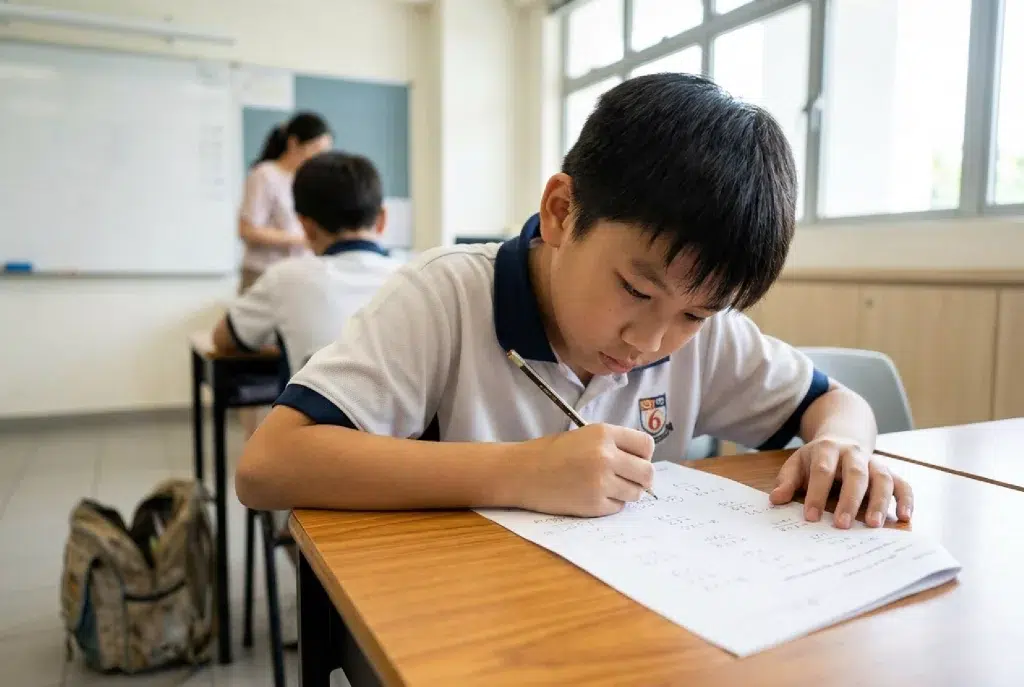
Primary 6 has a way of arriving faster than anyone expects.
One moment, you are thinking there is plenty of time. Next, the school is sending home letters about PSLE preparation, and your child is sitting at the table with a practice paper that looks nothing like what you remember from your own school days.
For many families in Singapore, this is the year everything feels suddenly urgent. And while that urgency is understandable, it is also where a lot of well-meaning parents go wrong. Panic-driven revision rarely produces the results families hope for. What actually works tends to look calmer, more consistent, and more targeted than most people expect.
Why P6 Maths feels like a step change
The difficulty spike between Primary 5 and Primary 6 is real, and it catches students off guard more often than it should.
It is not that entirely new topics appear out of nowhere. It is more than everything your child has learned over the previous five years that gets pulled together and tested in increasingly complex ways. A question in P6 might involve fractions, ratios, and a multi-step word problem all at once. Each individual concept might be familiar. Handling all of them together, under timed conditions, is a different challenge entirely.
This is why a child who seemed perfectly fine in P5 can suddenly feel lost at the start of P6. The content has not dramatically changed. The demands placed on how they use that content have.
What the PSLE Maths exam actually tests
It helps to be specific about this, because a lot of revision is aimed at the wrong things.
PSLE Maths is split across two papers. Paper 1 is worth 45 marks and does not allow a calculator. It tests speed, mental fluency, and a confident grasp of fundamental concepts through multiple-choice and short-answer questions. Paper 2 is worth 55 marks, allows calculator use, and focuses on multi-step problem solving. Students are expected to show clear working throughout, and marks are awarded for the correct method even when the final answer contains an error.
That second point changes things considerably. A child who understands the approach to a problem but slips up on arithmetic can still recover partial marks if their work is laid out clearly. A child who jumps straight to an answer, even a correct one, risks receiving nothing for that question if no work is shown.
Preparation that ignores exam technique is leaving marks on the table.
The topics that tend to cause the most trouble
Not all P6 Maths topics are equally demanding, and knowing where children typically struggle most can help focus revision time more effectively.
Ratio and proportion problems are consistently challenging because they require students to track changing quantities and relationships across multiple steps. Speed, distance, and time questions demand careful reading and a clear method before any calculation begins. Geometry and mensuration questions often trip students up, not because the formulas are hard to remember, but because the diagrams require spatial reasoning that does not always develop at the same pace as numerical skills.
Fractions remain a sticking point for many P6 students despite being introduced years earlier. A child who never fully consolidated fraction operations will feel that weakness sharply in P6 when it starts appearing inside more complex problem types.
The lesson here is that P6 revision should not start in P6. But if it has to, knowing which areas to prioritize makes a real difference to how efficiently that time is used.
Building revision habits that actually hold up
The families that tend to come through PSLE season in the best shape are not always the ones who revised the most. They are the ones who revised consistently.
Short, focused daily practice sessions outperform long, exhausting weekend marathons in almost every case. The brain retains mathematical processes better through regular exposure than through occasional intensity. Twenty to thirty minutes of genuine focus each day, working through problems and reviewing mistakes carefully, will compound into meaningful improvement over a term.
Reviewing mistakes is the part most children rush past, and it is often the most valuable part of any practice session. Not just correcting the answer, but understanding precisely where the thinking went wrong. Did they misread the question? Use the wrong method? Make a careless arithmetic slip? Each of those requires a different fix, and lumping them all together as simply getting things wrong misses the point.
Past papers from the Singapore Examinations and Assessment Board (SEAB) are worth using regularly throughout the year, not just in the months immediately before the exam. Familiarity with the format reduces anxiety and helps children pace themselves more effectively across both papers.
When your child needs more than home revision
There is a version of P6 preparation that works entirely at home with a motivated child, a supportive parent, and enough time to address gaps as they appear. That version exists. It is just not the reality for every family.
Some children have gaps that go back several years and need more systematic attention than a parent can provide at the kitchen table. Some have convinced themselves they are simply not a Maths person, and rebuilding that belief requires someone outside the family dynamic. Some just learn better with structured external support and the accountability that comes with it.
If any of that sounds familiar, finding good primary 6 (P6) PSLE Math tuition in Singapore is worth looking into seriously. The right program will not just cover syllabus content. It will identify exactly where a child is losing marks, address the underlying misconceptions rather than just drilling more questions, and work on exam technique alongside content knowledge. Small group settings work particularly well at this level because children get personalized attention without the pressure of being the sole focus of the entire session.
Getting the timing right
This is where most parents have regrets.
Starting structured support in the first half of P6 gives a child a full term to consolidate gaps, develop exam technique, and build confidence before the pressure of the final months sets in. Starting in Term 3 is still worthwhile, but leaves less room to address anything that takes time to sink in properly.
If your child is already in P6 and you have been waiting to see how things develop, this is probably the moment to stop waiting. Not because panic is the right response, but because calm, early action almost always produces better outcomes than rushed, late intervention.
Keeping the bigger picture in mind
PSLE matters, and it is reasonable for families to take it seriously. But it is also worth remembering that a child sitting this exam is eleven or twelve years old, carrying a level of pressure that previous generations of students at that age simply did not face.
The way you talk about the exam at home shapes how your child feels walking into that hall. A parent who is visibly anxious transfers that anxiety. A parent who acknowledges that this is important while also making clear that one result does not define a person gives their child something more valuable than any revision strategy: the ability to perform without fear.
Progress over perfection. Effort over outcome. A child who builds genuine understanding and walks in feeling prepared has already done the hard part.
A quick note on what to ask before choosing a tuition program
Before committing to any external support, it is worth asking a few direct questions.
How does the tutor identify what a child specifically does not understand? What does a typical session look like? How is progress tracked and communicated to parents? Are there resources available between sessions for when a child gets stuck at home? What experience does the tutor have with the Singapore MOE curriculum and PSLE in particular?
The answers will quickly tell you whether a program is genuinely structured around your child’s needs or simply offering more of what school already provides. For a year as significant as P6, that distinction is worth taking the time to get right.











Comments are closed.