

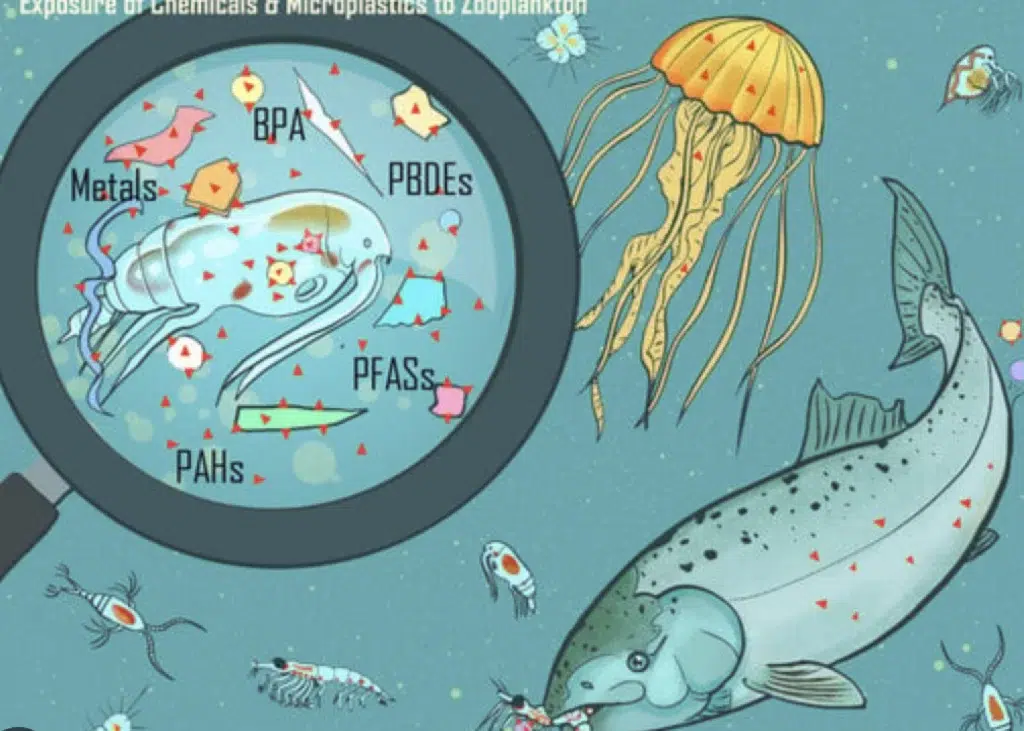
The average person inhales a credit card’s worth of microplastics every week. You may be wondering what microplastics even are, because the definition can easily be misconstrued. Microplastics aren’t large wrappers or even things we can see. Microplastics are tiny particles—less than five millimeters in size—that are shed from plastic items. They are found in oceans, soil, air, and virtually every ecosystem on earth. They’re often overlooked because they’re so hard to see, but in reality, they’re everywhere. As plastic waste continues to break down, the question isn’t whether or not we’re exposed to microplastics, but what it means for our future.
Entering the Ecosystem
Microplastics have a variety of sources. They can come from larger plastic debris that degrades into smaller and smaller pieces. Microplastics can also come from our clothing. The clothes we wear degrade over time, and each time we wash a garment, some portion of it frays away in the form of tiny microfibers. Sometimes they’re harmless, if the clothing is made of a biodegradable material, but if clothes are made from synthetic material, each washing can produce millions of microplastics. Another source is water. Rains, floods, and irrigation all wash away the microplastics on land into the ocean. Microplastics can also be carried by wind and deposited into both soils and bodies of water. The many ways microplastics enter our ecosystems tell us that every piece of plastic ever made leaves its lasting mark.
Environmental Impacts
Microplastics can have both physical and chemical effects on ecosystems. Physical effects include cell penetration, which causes damage to cell tissues. Microplastics damage cells by affecting essential macromolecules or hindering cell functions, such as mitochondria and the cell membrane. Another physical effect of microplastics is that they can alter the physical properties of soil by reducing water retention, increasing bulk density, and altering pore structure. These conditions can lead to soil compaction, which causes drier conditions, therefore hindering plant growth.
Chemical impacts on an ecosystem include the leaking of toxic additives into ecosystems by absorbing other pollutants onto their surfaces. This can lead to animals ingesting these plastics, which causes bioaccumulation through food webs. Bioaccumulation is the process by which toxin abundance increases from the producer to tertiary and quandary consumers as larger animals eat smaller ones. Toxic chemicals associated with microplastics can also leak into the water, altering aquatic ecosystem characteristics like water quality and dissolved oxygen.
Human Health Impacts
Microplastics go beyond the ecosystem, as they have been proven to have an effect on human health as well. As microplastics enter organisms, they make their way up the food chain, eventually reaching us. Microplastics have been found in numerous areas of the body, including the brain, placenta, intestines, stomach, and heart. Additionally, a study done by Stanford Medicine researcher Juyong Brian Kim, MD, revealed that “these plastics can get inside cells and lead to major changes in gene expression.” Kim further explains that “these findings suggest that the particles contribute to vascular disease progression, emphasizing the urgency of studying their impact.” However, there’s still a myriad of research left to be done. Scientists have only just begun to examine how microplastics are affecting us, but so far, variables such as the size, type, and shape of plastic have yet to be heavily studied. It’s also difficult to study specific substances because more than 10,000 chemicals are used to create plastic. We have a ways to go, but what we do know now is that microplastics can cause significant harm to humans, and we must all be aware of this invisible threat.
Actions to Take
In the meantime, all we can do is try to reduce the harm of microplastics to ourselves and the environment. Ongoing effort and awareness are essential as we work toward long-term solutions, but there are many simple actions that everyone can take right now.
Here are just a few:
Limit your consumption of synthetic clothing—buy clothing made from natural fibers like cotton and wool, which don’t have any microplastics in them.
Filter your water and air—use filters that use reverse osmosis or nanofiltration to capture airborne microplastics; Choose your products wisely—buy wood or glass items instead of plastic ones to limit the amount of microplastics in your home and the environment.
References
- Christopher, Amy. “The Microplastics Challenge: Solutions from Nature.” Mother of Corals, 29 Mar. 2024. https://motherofcorals.org/2024/03/29/the-microplastics-challenge-solutions-from-nature/?gad_source=1&gad_campaignid=22492823730&gbraid=0AAAAA-pHzfKrNkY7FZntF188pIRocoVSk&gclid=CjwKCAjwxrLHBhA2EiwAu9EdM0lthK36sjwyfxKSlC659TR7rgwjIgj6_hLalCbHl9hXIEMmiDC-JBoC9RwQAvD_BwE.
- National Oceanic and Atmospheric Administration. “What Are Microplastics?” Last updated: 16 June 2024. https://oceanservice.noaa.gov/facts/microplastics.html.
- Plastic Pollution Coalition. “A Breath of Fresh…Plastic? Humans Inhale a Credit Card’s Worth of Microplastics Every Week.” 7 Mar. 2024. https://www.plasticpollutioncoalition.org/blog/2024/3/7/humans-inhale-a-credit-cards-worth-of-microplastics-every-week.
- Savchuk, Katia. “Microplastics and Our Health: What the Science Says.” Stanford Medicine, 29 Jan. 2025. https://med.stanford.edu/news/insights/2025/01/microplastics-in-body-polluted-tiny-plastic-fragments.html.(Image) Weis, Judith S., and Juan José Alava. “(Micro)Plastics Are Toxic Pollutants.” Toxics 2023, 11(11), 935. https://www.mdpi.com/2305-6304/11/11/935.







Comments are closed.