
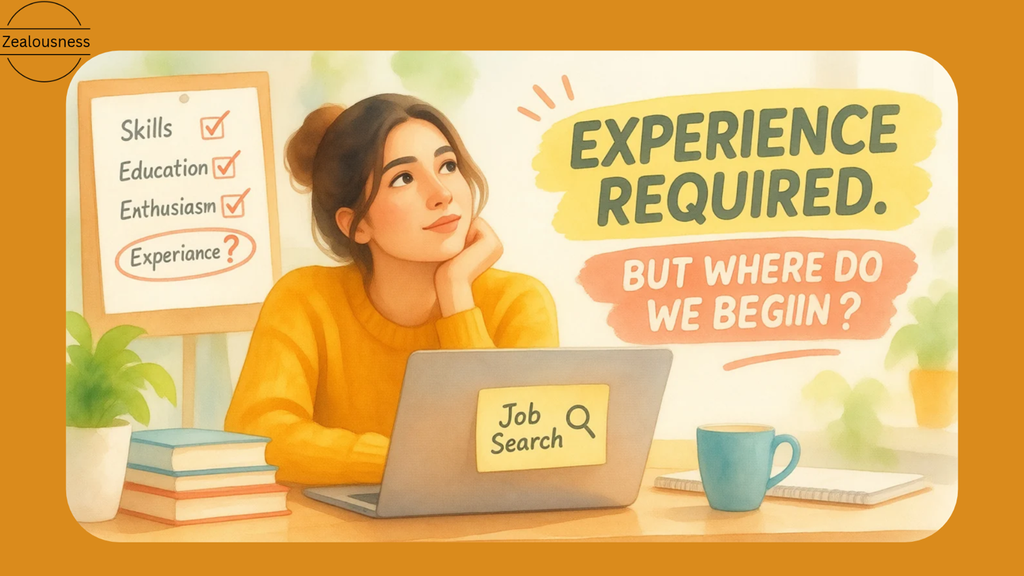
You have finished your studies, updated your resume, and are excited to apply for your first job. You’re browsing around and come across a vacancy that says entry-level. Perfect really. That’s it, that’s your chance.
Then you read the requirements: Minimum two years of professional experience. And suddenly, you are left wondering: How am I supposed to gain experience if nobody gives me a chance to start?
For many young people out there, this is a familiar situation. We encourage them to study hard, to get their skills up, and prepare for their future. Yet, when they finally step into the professional world, they may discover that being prepared doesn’t necessarily get you the job
When Entry-Level Jobs Are Not Really Entry-Level
Of course, employers need people who can manage responsibilities, meet deadlines, and contribute to their teams. Previous experience can be a great reassurance. But do you really expect someone applying for their very first job to have years of experience already?
According to the International Labor Organization (2024), global youth unemployment stood at 13 percent in 2023, the lowest level in 15 years. That said, a very large number of young people were still not in a position to get decent, secure work.
Not every young person’s circumstances are the same. The gap between what employers are looking for and what a fresh graduate can realistically offer is one that absolutely needs to be addressed.
After all, experience has to begin somewhere.
What About the Skills We Cannot See on a Resume?
Imagine two candidates applying for the same position. One has already worked in a similar role. The other has recently graduated, completed challenging projects, volunteered, and learned to solve problems independently.
The first candidate may seem like the obvious choice. But does that mean the second has less potential?
A job title can tell us where someone has worked. It does not always tell us how willing they are to learn, how they respond to challenges, or what fresh ideas they might bring. An employer could look beyond the resume and consider a portfolio, a practical assignment, or a skills-based interview.
Young people can also benefit from taking their everyday learning into a resume experience, especially when they have not yet held a formal job.
This is absolutely not about lowering the bar. It’s about giving people different ways in which they can demonstrate what they can do.
Internships: An Open Door for Everyone?
Internships and apprenticeships can offer that first step. They help young people understand workplace expectations, build confidence, and discover how their abilities translate into professional settings.
But even these opportunities come with challenges.
Research from the National Association of Colleges and Employers found that paid interns, on average, received more job offers prior to graduation than unpaid interns or students with no internship experience at all(Gray 2024).
Now consider a student who needs to be earning money while they’re studying. Can they afford to work unpaid for several months? For some, the answer is yes (an unpaid internship is an option). For others, it is simply not an option.
If we want young people from different backgrounds to succeed, opportunities must be accessible rather than just available.
Small Opportunities Can Make a Big Difference
Not every organization has the resources to run a large internship program. However, even small-scale opportunities can help young people in terms of gaining valuable experience.
Here are a few ways employers and educators can contribute:
- Offer short-term projects: Provide paid assignments that allow students to develop practical skills.
- Encourage mentorship: Connect young people with professionals who can offer guidance and support.
- Promote hands-on learning: Involve students in real-world projects to build confidence and experience.
- Provide feedback: Help young people recognize their strengths and areas for improvement.
- Encourage volunteering: Help young people find volunteer opportunities where they can develop practical skills, gain experience, and build relationships that may lead to references or letters of recommendation.
These opportunities benefit employers, too. According to the National Association of Colleges and Employers, 63.1 percent of interns in the 2024–25 cohort transitioned into full-time employment among surveyed organizations (Gray 2026).
While internships don’t necessarily lead to a job, they can open doors to future careers. Educators can support this process by connecting students with organizations and promoting the value of hands-on experience and work-based learning.
Another important step is encouraging young people to explore opportunities in fields they genuinely enjoy. For example, someone who dreams of becoming a veterinarian might begin by volunteering at an animal shelter or gaining experience in animal care. These small steps can help them understand their chosen profession, build connections, and discover opportunities they might otherwise overlook. Sometimes, finding the right direction matters just as much as gaining experience.
Someone Has to Offer the First Chance
Young people must take responsibility for their own learning, improving their skills, and for making the most of the opportunities that are available to them. We cannot just put the onus of career readiness entirely on those who are still in the process of getting into the workforce.
Employers have expectations. Young people have aspirations. Somewhere between the two, there needs to be room for growth.
A first job isn’t meant to be evidence that you already know it all. It should be a place where you can learn.
Before asking young people what experience they have, perhaps we should ask ourselves what opportunities we’ve actually given them to gain that experience.
References
- Gray, Kevin. 2024. “Students Recognize the Importance of Gaining Internship Experience.” National Association of Colleges and Employers, September 23, 2024. https://www.naceweb.org/job-market/internships/students-recognize-the-importance-of-gaining-internship-experience
- Gray, Kevin. 2026. “Intern Conversion Rate Hits Highest Mark in Five Years.” National Association of Colleges and Employers, April 3, 2026. https://www.naceweb.org/talent-acquisition/internships/intern-conversion-rate-hits-highest-mark-in-five-years.
- International Labour Organization. 2024. Global Employment Trends for Youth 2024. Geneva: International Labour Organization. https://doi.org/10.54394/ZUUI5430.