What if one of a student’s most memorable lessons came from someone sitting in a classroom thousands of miles away?
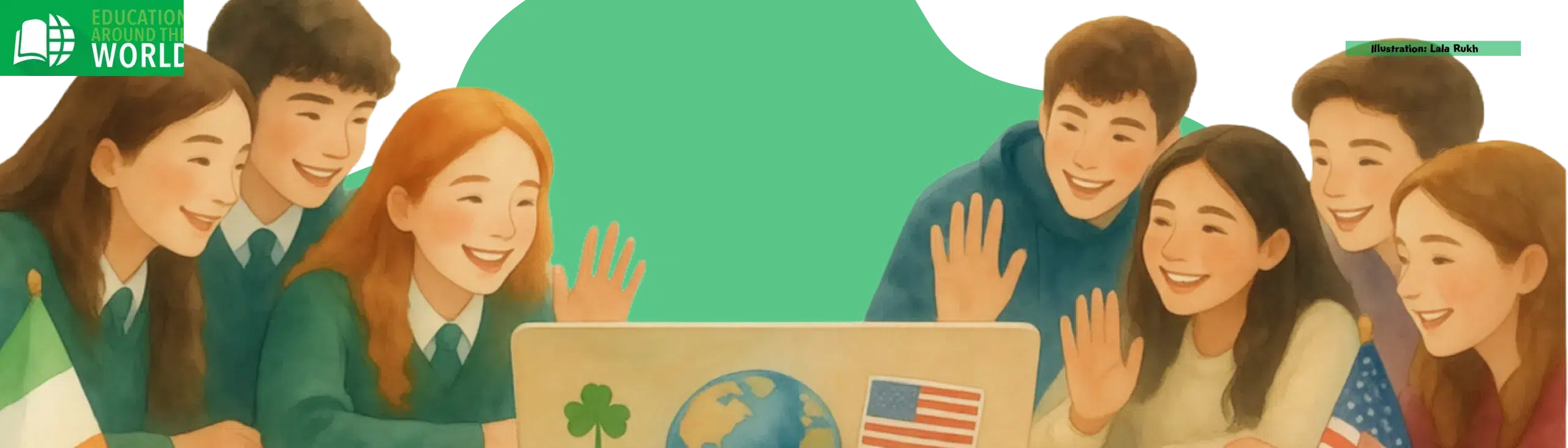
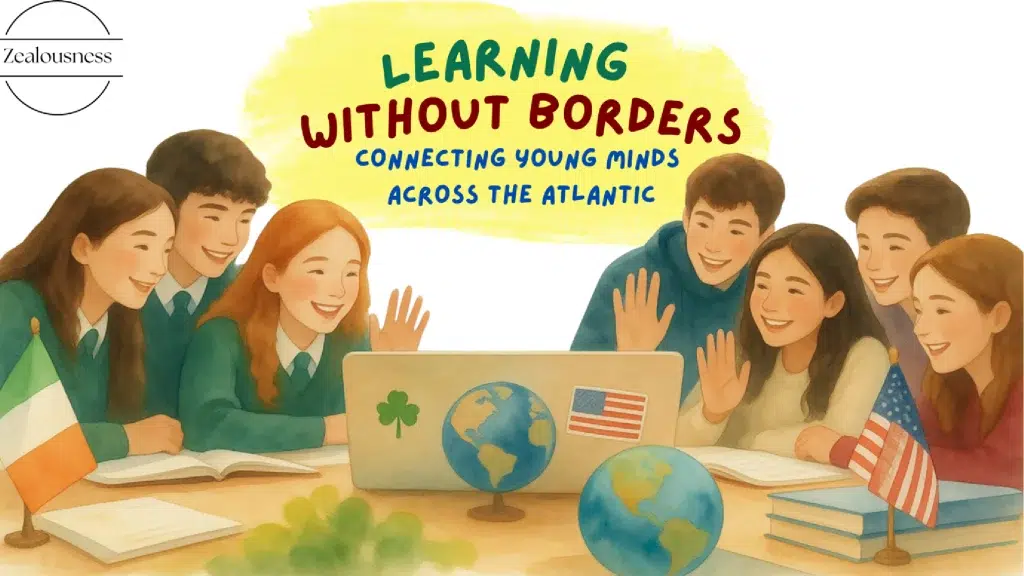
Picture two classrooms, one in Ireland and the other in the United States. The students may follow different school routines, celebrate different traditions, and grow up surrounded by different landscapes. Yet a simple conversation could reveal something unexpected: They have more in common than they had imagined.
For generations, international learning has often meant traveling abroad. Today, technology offers another possibility. Students can exchange ideas, explore unfamiliar cultures, and work on shared projects without leaving their classrooms.
Across the Atlantic, this opens a wonderful opportunity for Irish and American students to learn not only about each other but also from each other.
When a Little Boat Connected Two Classrooms
Sometimes, the most remarkable educational connections begin in unexpected ways.
In 2022, students at Morristown Beard School in New Jersey launched a miniature sailboat called Crimson Current as part of an educational project exploring ocean currents and geography.
After traveling across the Atlantic, the boat reached the coast of County Cork, Ireland, where residents helped recover it. The boat eventually reached Barryroe National School, creating an unexpected connection between two groups of students.
But the story didn’t end with the boat’s arrival.
In October 2022, students from both schools met on a Zoom call. The Irish students shared aspects of life in West Cork, demonstrated hurling, played Irish music, and introduced their American peers to a few Irish words.
The connection continued through handwritten letters, with students exchanging thoughts about school, hobbies, food, sports, and everyday life (Educational Passages n.d.).
What began as a geography project became something much more personal: an opportunity for young people on opposite sides of the ocean to discover each other’s worlds.
The relationship continued beyond that first exchange. In March 2025, students from Morristown Beard School visited their Irish counterparts in Cork, bringing a connection that began at sea into the real world (Educational Passages n.d.).
It is a wonderful reminder that meaningful education sometimes develops beyond the original lesson plan.
More Than a Video Call
Virtual learning is often associated with online lectures or digital assignments. But connecting with students in another country can make learning feel entirely different.
Instead of simply receiving information, students become active participants in a shared experience.
An Irish classroom might explore local coastal conservation while American students investigate environmental issues in their own communities. Together, they could compare findings, ask questions, and create a digital presentation.
The International Education and Resource Network (iEARN-USA) supports this approach through virtual student exchanges. Its programs bring students from different countries together to explore educational themes, including projects connected to the United Nations Sustainable Development Goals (iEARN-USA n.d.).
The important element is not the technology itself. It is what students do with it.
A screen becomes valuable when it encourages a student to listen more carefully, consider another perspective, or approach a familiar subject in a new way.
More Than Knowledge: What Can Students Learn Across Borders?
International collaboration can introduce students to experiences that textbooks alone may struggle to capture.
Consider how differently young people might describe the same subject. A lesson on local history could prompt Irish students to share stories from their communities while American students explore their own regional heritage.
Neither perspective needs to be more important than the other. The learning happens through comparison, curiosity, and conversation.
UNESCO’s framework for global citizenship education identifies three interconnected areas of learning: cognitive, social-emotional, and behavioral. These involve understanding the wider world, recognizing shared humanity and diversity, and developing the ability to act responsibly (UNESCO 2015).
When students work with peers from another country, these lessons can become more than just ideas on a page.
Such exchanges may also encourage students to question assumptions. Their understanding of another country might initially come from movies, social media, or familiar stereotypes. Hearing about it directly from someone their own age can offer a more personal and thoughtful perspective.
Bringing Global Learning into Everyday Classrooms
The encouraging part is that international collaboration does not always require an elaborate program.
Organizations such as iEARN-USA provide structured opportunities for classrooms to collaborate internationally, including projects that can be incorporated into existing lessons (iEARN-USA n.d.).
Teachers can also begin with a simple activity of their own.
A Simple Classroom Activity: “Sharing Our Worlds”
An Irish and an American classroom could explore three questions:
- What makes our local community special?
- What challenges do young people in our community experience?
- What would we like students in another country to understand about our lives?
Students could share short reflections, drawings, photographs, or teacher-approved videos before discussing what surprised them.
Of course, thoughtful planning matters. Teachers should consider time-zone differences, accessibility, parental permissions, and student privacy. UNESCO (2024) emphasizes the importance of helping learners engage critically, ethically, and responsibly in digital environments.
Teachers do not need to reinvent their lessons. Sometimes, just bringing another classroom into the conversation is enough to open up a whole new perspective.
A Bigger World Begins with a Small Conversation
The story of Crimson Current shows that learning across borders does not always begin with a grand international initiative. Sometimes, it begins with a small boat, a curious group of students, and a willingness to connect.
An ocean may separate Ireland and America, but their classrooms can still become places of shared discovery.
When students exchange experiences, ask thoughtful questions, and work toward a common goal, they begin to understand something valuable: Different backgrounds do not have to prevent meaningful connections.
Perhaps that is one of the most important lessons that education can offer to an individual.
The world becomes a little smaller when young minds are encouraged to think beyond their own borders.
“The distance between two classrooms may be measured in miles, but the connections they create can go far beyond borders.”
Related Reading
Curious about how international experiences can shape a student’s future? Explore Unlock Your Potential: The Benefits of Global Learning to discover how learning beyond familiar surroundings can encourage cultural understanding, personal growth, and new opportunities.
References
- Educational Passages. n.d. “Crimson Current.” Accessed October 14, 2026. https://educationalpassages.org/boats/crimsoncurrent/.
- iEARN-USA. n.d. “Virtual Student Exchange.” Accessed October 14, 2026. https://us.iearn.org/our-programs/virtual-student-exchange/.
- UNESCO. 2015. Global Citizenship Education: Topics and Learning Objectives. Paris: UNESCO. https://doi.org/10.54675/DRHC3544.
- UNESCO. 2024. Global Citizenship Education in a Digital Age: Teacher Guidelines. February 23, 2024. https://www.unesco.org/en/articles/global-citizenship-education-digital-age-teacher-guidelines.